A portion of the "core-zine" collection from WCAD is now on exhibit at Cheekwood Museum in the Post-45 Gallery. Two of the zines on display were created by Watkins students! Here is a write up about the show:
Artists’ Books from Postwar to Present
April 19 - July 6In the late nineteenth century, publishers began to employ artists as illustrators. These books were often printed on fine paper and considered luxury items. Over the course of the twentieth century, artists expanded the idea of an “artist’s book” to new levels. This exhibition will include books by artists such as Kara Walker, Stanley William Hayter, Jasper Johns, Richard Diebenkorn, Robert Motherwell, and John Baldessari.
A great review of this show titled "Literary Beauties" was published in the Nashville Scene
Monday, May 12, 2008
ARLIS 2008 post mortem
I have returned to a whirlwind in Nashville with many ideas to set into place before I leave Watkins. I am gathering my notes and will write about some of the conference soon. I did want to create a link to a hidden post on ArLiSNAP (a blogging community for new art library professionals and students). The following link will take you to a very thorough bibliography on art librarianship created by B.J. Irvine in 2005 from the University of Indiana for her art library students.
Saturday, May 3, 2008
ARLIS, 2008
I've decided that the annual North American Art Libraries Association (ARLIS) conference would be a good time to break my blogging hiatus to write about what I am learning. This year's conference is in Denver, it is May but cold and snowy here, yikes! In regards to my hiatus I will write about it at length soon, but for now I will say that I have been busy turning the tools that I originally posted on this blog into a more user-friendly format on my website http://virginiaallison.com/, check it out!
This semester has provided many challenges that may or may not lead to my enrollment in graduate school with VCU's MATX program or a new position as an art librarian outside of Nashville. Change is a constant part of life, and I am anxious and sad to be leaving the wonderful community I have found in Nashville, but excited for new challenges and adventures to come.
It is day two of the conference and already I am floored with gratitude for my art librarian community. I've found a great group of new professionals (ARLISNAP) who have accepted me into their fold. I've enjoyed hearing from the experiences of others who are new to the profession. Navigating the many critical decisions that we are faced with as newbies, it is helpful to share experiences and advice with others who are in the same boat. These people are my people and as a somewhat solo librarian, I get gitty to be amongst other art librarians.
-Z
Wednesday, December 12, 2007
Art in the Bibliosphere

This semester 12 students added to our zine collection!


At the end of this semester I lead a project with my dear friend and colleague Lauren Kalman for her class, "Art in the Public Sphere." We decided to do a political/interventionist project in which I presented on the political/historical aspect of zines and artists' publications. We then asked students to create a zine themselves in which they submitted one to printed matter, one to zine world, and dropped off the rest of their batch of 15 all over the city.
Tuesday, November 13, 2007
Nashville Homeless Paper
Nashville has a bonified homeless paper thanks to the hard work of many volunteers! The first volume of this project has just been issued and is available at the Watkins College of Art and Design Library.
The name of the paper:
The Contributor: Diverse perspectives on homelessness. Genuine opportunities for advancement.
Here is their press release...
First Issue of The Contributor Hitting the Streets
Newspaper designed to provide perspectives on homelessness
Nashville, TN – On Wednesday, November 14th, a new and original newspaper arrives on the streets of downtown Nashville. The paper was created to assist the public in understanding the challenges and difficulties associated with homelessness for everyone while providing employment opportunities for homeless individuals.
The Contributor will provide diverse perspectives on the condition of homelessness while also highlighting the contributions of homeless and formerly homeless individuals.
“Homelessness in Nashville is an issue that is looked at in many diverse ways,” said Executive Director Tasha French. “We will be working directly with homeless and formerly homeless people to create a forum for all these perspectives.”
All of the vendors selling The Contributor are either homeless or formerly homeless.
They will start out with a number of free papers, selling each for $1. After generating some income, each vendor can come back and purchase additional issues for just 25¢ per issue. The profits of the sale of the paper will be directly to the vendor.
In addition, one key goal of The Contributor is to have at least 50% of the content in each issue be from homeless and formerly homeless individuals.
“We want to give our vendors an opportunity to earn an income, eliminate stereotypes and share their stories as homeless men and women,” said Director of Vending Steve Samra. “Instead of panhandling, our vendors have a product they can provide, and hopefully this paper can initiate a new and healthy dialogue between people across the socioeconomic spectrum.”
The first batch of papers will be distributed to vendors at 2pm at the Downtown Presbyterian Church at 5th and Church and will be sold at major street corners in the downtown area.
For more information about the publication, or to offer writing submissions, please contact Executive Director Tasha French at (615) 598-0061 or online at thecontributorstaff@gmail.com.
Wednesday, October 31, 2007
Vamp & Tramp comming to Watkins!

You are invited:
Learn about the growing world of artists' books!
Watkins College of Art & Design
Monday, Nov. 5 at 4pm
Room 502
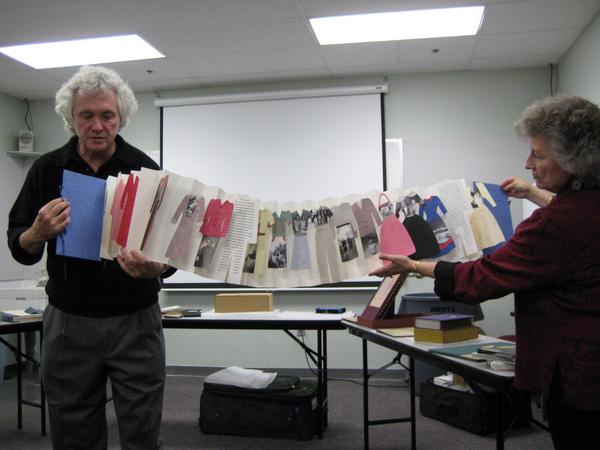
Vicky and Bill Stewart – as Vamp & Tramp, Booksellers – represent 200+ contemporary fine presses and book artists. They spend much of the year traveling the US taking the works they represent to private and institutional customers.
On November 5, they will be at Watkins talking about the burgeoning world of artists' books and sharing examples from their inventory. Please join us for their presentation followed by a reception.
Overview of Sandra Kroupa’s role in the University of Washington’s Book Arts Collection -
“My job is primarily to be the conduit between the artist and viewer. The artist can’t talk to the person directly, but they can talk to them through me as I provide the book.”
Wednesday, August 15, 2007
"Zines" covered in the Nashville Scene
Transcending the Internet
Local zine artists and librarians work to keep underground publishing alive
by Maria Browning
“They’re dickscapes...landscapes made out of dicks.” That’s local artist and zinemaker Kate “Kuss” Csillagi describing one of the recurring motifs in her graphic zine Romance. It’s hard to pin down a definition of “zine,” a catchall word used for any low-budget, self-produced magazine, but the idea of a “dickscape”—whimsical, provocative, completely idiosyncratic—is the perfect embodiment of the zine aesthetic.
Photo
The content of a zine can be almost anything—political rants, music and movie reviews, literary navel-gazing, comics, you name it—but it’s generally rooted in a skeptical attitude toward mainstream culture. A zine can’t be a product of the commercial media, no matter how hip or niche. Some “zinesters” like to play with unusual forms, such as imaginary letters folded into envelopes or grab bags of hand-painted postcards, but the final product, according to zine purists, must be on paper.
The zine had its heyday beginning in the late ’70s, emerging from the punk scene and then rippling out into the wider underground culture. Zinemaking thrived for the next 20 years, until the Internet happened. The teenagers and young adults who made most zines got hooked on blogging and MySpace. “Ezines” replaced their hard-copy forebears. Paper became passé. At the same time, market pressures forced many of the independent book and record stores that sold zines to close their doors. Nashville artist and musician Angela Messina, former proprietor of the defunct Halcyon Books and herself a zinemaker and collector of zines, says, “It is definitely a dying thing.”
But Jerianne Thompson, a Murfreesboro librarian and the publisher of Zine World: A Reader’s Guide to the Underground Press, disagrees. She feels that the Internet has simply “cut out some of the crappier zines. A lot of the people who are doing zines now are more dedicated to it.” Thompson is among a handful of devoted zine lovers in the Nashville area who are doing their best to nurture the form. At the Linebaugh Public Library, she has established a circulating collection of approximately 125 zine titles from around the country. She taught a workshop on zinemaking for kids in June, and more workshops are planned at the library this fall, including one for “artsy moms.”
Thompson’s Zine World, which is published roughly three times a year, promotes the genre with thumbnail critiques of dozens of titles, along with short news reports and columns about trends in zinemaking and the decline of free speech. Zine World is well written and carefully put together—no surprise, given the profession of its publisher—but it’s got more than a touch of the classic zinester attitude. “If you are not fully satisfied with Zine World, tough shit,” is a typical line on the subscription page. It’s clear that Thompson is a participant in the zine culture as much as a preservationist of the form.
Another local librarian with a passion for zines is Virginia Allison of Watkins College of Art & Design. The library at Watkins is in the process of developing its own zine collection, and Allison has produced a resource guide for libraries and others interested in collecting zines. Along with Thompson, she has guest-lectured on the subject for Watkins courses, and runs workshops on zinemaking for students.
Allison sees a resurgence of interest in zines that is, at least in part, a reaction to the forces that initially siphoned interest away—the consolidation of media and the dominance of digital communication. She considers zine culture an indirect descendant of the Dadaist movement, with its rejection of bourgeois values and conformity. On an aesthetic level, zinemaking appeals to people who want to communicate via a medium that isn’t straitjacketed by a template and screen. “There’s something about putting things on paper that is nostalgic and beautiful,” she says.
There are a number of well-known Tennessee-based zines, including the venerable anarchist publication Fifth Estate, which is co-produced by the Pumpkin Hollow community outside Liberty, and RR, authored by “D. Striker,” the alter ego of musician Jeff Meltesen. RR is published every Friday the 13th in conjunction with a performance/party that has become a local institution. Uprise, a comparatively slick zine with a sizable circulation, is devoted to Christian heavy metal music and skateboarding. Its creator, Belmont student Dave Darr, admits to having some commercial aspirations for his publication that are not entirely in keeping with zine tradition, but like most zinesters he’s primarily interested in expressing his particular view of the world. He gives away 90 percent of the 5,000 copies per issue, saying, “Basically, I just want to serve God. I don’t care about being a millionaire.”
Photo
But most local zinesters operate well under the radar, pretty much unknown outside their small cohort of friends and fans. Jerry Smith of Morristown creates two zine comics, Southern Fried and Rattletrap, which chronicle his youth and his small-town Southern life. Kuss Csillagi has been producing Romance since 2003. A onetime tagger who decided she really didn’t approve of marking up other people’s property, Csillagi takes pleasure in comparing early issues of her zine to “a coloring book for a perverted 12-year-old.” She sees her work as a personal expression that she’s more interested in sharing than selling. She is currently experimenting with the use of video, but is committed to continuing the paper zine.
Even as they’ve become scarcer over the past decade, zines have gained a certain artistic legitimacy, and have been swept up on the growing enthusiasm for the book as an abstract form. Cheekwood plans to include zines in a large book-art exhibit scheduled for April 2008. But for the people who make them, and the readers who take the trouble to hunt them down, they remain a way of communicating, as Angela Messina says, “on a human scale. The appeal is the simplicity. You feel a connection with someone somewhere else.”
Subscribe to:
Posts (Atom)